Why Canada Makes a Useful Early-Web Starting Point
The.ca domain was created in 1987. CIRA’s history of the.ca domain places this milestone firmly in the late eighties, providing a verifiable anchor for structural ontology. We are not looking at a novelty theme. Canada makes a useful early-web starting point because it represents a structured, public-facing web space. This is a practical recommendation list for readers who want to browse institutions, local culture, utilities, and handmade web traces. The goal is to extract what a modern web wanderer can still learn from these older patterns of publishing.
Early digital repositories required explicit architectural decisions. Before commercial standardization smoothed over the friction of navigation, every hyperlink and directory structure was a deliberate choice. Exploring this specific national subset of the early internet offers a concentrated look at how public information was organized. The ten recommendations that follow are grouped into public-interest, culture-memory, utility, local, and handmade categories. They serve as a functional newsletter archive of early hypertext theory in practice.
Criteria for Selection: What Counts as a Good Early-Web Recommendation
A good early-web recommendation must reveal something structural about Canadian place, public service, local culture, education, media, or web discovery habits. Each candidate should answer specific questions. Who was the page for? What public or local need did it serve? What browsing behavior did it encourage? We prioritize resources that are still browsable, have archived traces, or represent a recognizable early-web pattern. University roots, government utility pages, public broadcasters, community networks, directories, museums, and personal publishing form the core of these web finds & curiosities.
Good comparison windows for early-web page style are the mid-1990s through early 2000s. Look closely at directory labels, contact blocks, update stamps, text-heavy layouts, and hand-maintained link lists. These elements expose the human labor required to maintain early digital tools & productivity systems.
Important: Archived pages can preserve layout and wording while losing scripts, search forms, images, maps, or linked files. A capture may show the shell of a site without the full user experience. Dates and archived page states should be treated carefully because many sites have been redesigned, migrated, or partially lost. Check across more than one capture, preferably a few snapshots spaced across different years when available.
The Public-Interest Web: Campuses, Classrooms, and Civic Access
Institutional pages document launches, migrations, and mandates better than they document who was left out. We begin with the public-interest web to see how national connectivity was imagined and implemented.
1. The.ca origin trail
Position UPEI and the official.ca history as the first recommended doorway. This does not explain all Canadian web culture. It anchors the tour in a real domain-history milestone. Understanding the administrative roots of the top-level domain provides necessary context for the structural logic that followed.
2. SchoolNet
This serves as a lens on how education, classrooms, and national connectivity were imagined online. Look for teacher resources, classroom language, curriculum-adjacent navigation, and student-facing links. Avoid overclaiming reach unless confirmed in drafting; do not assume a uniform classroom experience. The rhetoric of national connectivity often outpaced the physical infrastructure available to individual schools.
3. National Capital FreeNet
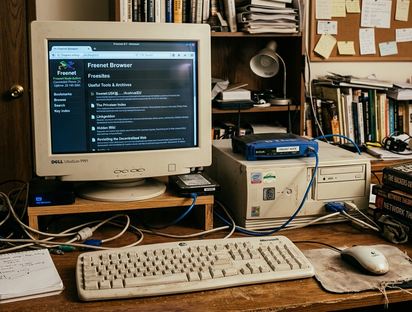
The early web overlaps heavily with civic participation here. Useful evidence includes local discussion areas, public help pages, account or access explanations, and volunteer language. Civic categories show internet onboarding as a community service. The FreeNet model treated digital access as a fundamental public utility, shaping the interface to prioritize low-bandwidth text communication and local civic engagement.
Culture and Memory: Where Canadian Stories Became Browseable
Strong early-web recommendations are not merely old-looking. They show how institutions taught users to browse, search, cite, and trust information online. The sequence from reference authority to media archives helps readers see how Canadian knowledge became browseable.
4. The Canadian Encyclopedia online
This is a practical reference-style stop. Inspect search behavior, article structure, cross-links, and author or editor cues. Observe how print-like authority was adapted for web browsing. The transition required inventing new navigational paradigms to map alphabetical print volumes onto associative hypertext networks.
5. CBC Archives and early broadcaster pages
Broadcaster archives offer a way to explore how audio, video, timelines, and public memory were organized for web audiences. These were arranged for readers rather than treated as a simple media dump. The architectural challenge was presenting time-based multimedia & web tech within a static HTML environment.
6. Canadian Heritage Information Network and museum web projects
Museum-facing web projects act as a bridge between collections, classrooms, and public interpretation. Focus on collection access, exhibit navigation, and object records. Official museum portals preserve curated culture rather than the whole cultural web.
7. Library and Archives Canada web traces
This is a tested verification habit. Compare current institutional pages with archived traces. A polished current institutional page can erase the browsing experience that made an older version distinctive. The failure case is treating the present-day site as proof of the early-web design—a common trap in digital tools & productivity research.
Field Note: University and government traces often preserve dates and mandates better than informal, Indigenous, immigrant, youth, fan, or neighborhood web histories. Always account for this structural bias when analyzing archival captures.
Useful, Local, and Handmade: The Web Canada Used Day to Day
Moving from durable public utilities to local identity and finally to the handmade layer mirrors how many people encountered the web. They came first for practical information, then for local connection.

8. Environment Canada and weather pages
Weather remains a durable utility category. Readers can compare how public information design handled forecasts, warnings, maps, and regional navigation. Location choice presentation is a good study in early interface logic. Mapping spatial and temporal data onto early HTML required significant architectural ingenuity.
9. Municipal visitor and city pages
Use city pages from places such as Toronto, Vancouver, Halifax, Winnipeg, or smaller municipalities as examples of early local web identity. Inspect tourism copy, council information, service directories, transit links, library links, and local event calendars. Availability varies heavily by archive depth, but these pages offer a raw look at places & local culture.
10. Campus clubs, zines, personal pages, and local directories
End the numbered list with the handmade layer. These pages may be messy, partial, or hard to verify—yet they often carry the strongest sense of early-web voice. Look for guestbooks, 'under construction' text, hand-coded links pages, webring-style navigation, personal recommendations, and last-updated lines. For handmade pages, authorship, dates, and continuity should be checked against contact details, footer timestamps, linked profiles, directory paths, and nearby pages from the same host. Where archival directory paths establish continuity, the pattern emerges: handmade pages carry the strongest sense of early-web voice.
Bottom Line: The guestbook is not just a curiosity. It represents a primitive form of asynchronous social networking, demonstrating how early users hacked static pages to create community dialogue.
Copy This 20-Minute Canada Web Dig
Minute 0 to 3: open a notes document with three columns labeled 'page', 'what it was for', and 'what makes it feel early-web'.
Minute 3 to 8: start with the official.ca history and record the 1987.ca creation point as the chronology anchor.
Minute 8 to 13: inspect one public-interest page, such as SchoolNet or the National Capital FreeNet. Look for navigation labels, help language, contact details, audience wording, and outbound links.
Minute 13 to 17: inspect one cultural-memory page, such as The Canadian Encyclopedia, CBC Archives, a museum portal, or an archival institution page. Save one reference or media artifact.
Minute 17 to 20: inspect one municipal, campus, club, zine, personal, or directory-style page. Save one odd local detail, such as a guestbook link, event calendar, hand-maintained resource list, or update notice. For example, a 1998 capture of a Halifax city page might still show a maroon-and-grey table layout, a 'last updated' line reading 'March 12', and a footer email link to a webmaster whose address ends in a defunct university domain—three small traces that together date the page more precisely than the archive stamp alone.