The Argument: Discovery Worked Because Editors Took Sides
Early web discovery worked best when it stopped pretending to be neutral. The useful newsletters did not merely point at the web; they made a small wager on what deserved attention that week.
The Cool Tricks and Trinkets Newsletter is useful here as an editorial pattern, not just as a fond object from the newsletter archive. Its value was not that it could list every strange tool, short film, personal page, or creative resource on the open web. Nobody could do that cleanly for long. Its value was that someone chose, sequenced, and explained a few web finds & curiosities before the reader had already decided they mattered.
A directory says: here is the category. An opinionated newsletter says: here is why this one item is worth your afternoon.
The useful bias
That bias matters. Curation depends on selection, framing, and timing more than exhaustive coverage, especially when the artifact crosses categories. A link to a film, a browser toy, or a lesson plan sits there silently until the editor gives it a reason to move.
Bottom Line: A discovery newsletter is not a smaller search engine. It is a sequence of judgments, each one trying to make an unfamiliar object legible at the moment it appears.
The Link Was Never the Whole Product
A raw link feels efficient until it lands in front of a reader with no memory of the page, no context for the maker, and no clue whether the click is worth the modem time.
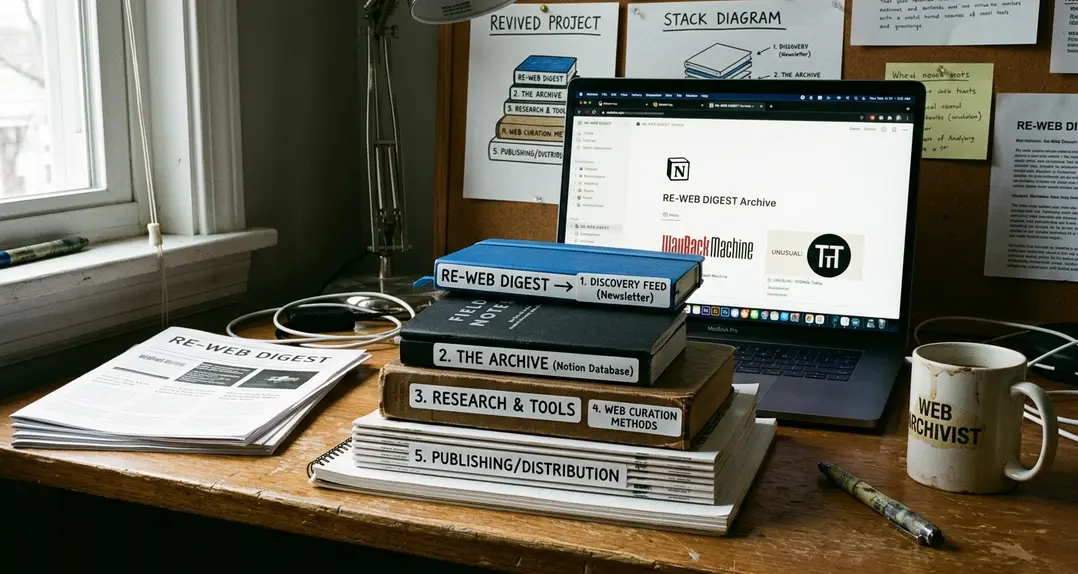
The stronger early items had a stack. Not a complicated one, but a dependable one: headline, short setup, credibility cue, why-it-matters sentence, and implied audience. That five-part shape still works for modern digital tools & productivity roundups, classroom resource lists, and archival notes on multimedia & web tech.
The five-part stack
- Headline: name the tension, not just the thing.
- Setup: give the reader one clean sentence about what the artifact is.
- Credibility cue: use a concrete fact such as a release date, creator name, production method, or known portal pickup.
- Why it matters: translate novelty into relevance.
- Implied audience: signal whether this is for teachers, archivists, writers, tinkerers, or the merely curious.
For a short film, the credibility cue does not need to become a statistical claim. A date, a production method, and a circulation path can do more useful work than a grand audience number nobody can verify. A practical discovery entry often lives in roughly the 55-110 word range when the goal is to make someone click, save, or teach the item rather than read a full essay.
Important: This pattern is weakest for emergency information, legal instructions, or medical guidance, where taste should not outrank verification and completeness.
Why 405 Was the Perfect Early-Web Discovery Item
June 5, 2000: 405 appeared on the web. June 9, 2000: a major web-video portal picked it up.
That tight four-day window is the whole lesson in miniature. The short film, made by Jeremy Hunt and Bruce Branit, had the kind of mixed signal that early newsletters loved: cinematic craft, web-native circulation, and a production story that made people lean closer to the screen.
The magnetism was not just the film
405 was not interesting only because it was polished. It was interesting because its polish arrived through a web distribution path and carried a production context worth preserving. The effects work involved LightWave 3D, RealVideo-era circulation, and production associated with consumer PCs rather than the high-end workstation model many readers expected from professional effects houses.
That bundle made the item easy to underestimate and hard to categorize. Was it a film item? A CGI item? A web video item? A story about independent production? Yes, and that is exactly why an editor had work to do.
The newsletter move would not be to proclaim it as the future of everything. The move would be smaller and sharper: here is a polished effects short behaving like a web-native object, and here is why that matters this week.
The Directory Counterargument Misses the Human Signal
The directory argument has a fair case. Cataloging, indexing, and directory maintenance gave the early web a kind of civic order. A reader looking for places & local culture, web design tutorials, or freeware utilities needed shelves.
But shelves help most when the reader already knows what kind of thing they want.
Retrieval is not recognition
A directory label such as video or tools can help retrieval, but it will not explain why a cross-category artifact deserves attention before the reader already knows to search for it. That is the gap newsletters filled. They helped people recognize unknown value.
405 can be plausibly tagged at least five ways: short film, CGI showcase, web video, independent production, and internet-culture artifact. A category-first treatment flattens that mix into one shelf. An editorial treatment can lead with the conflict: a polished effects film circulating through early web-video channels rather than through the expected theatrical or studio path.
Field Note: When a find crosses categories, lead with the tension instead of forcing it into a single label. The tension is often the reason the item is worth saving.
This is where a raw bookmark archive can disappoint. A collection with hundreds of uncategorized links may be historically rich, but it becomes editorially weak if it gives no hook, proof, audience, or action. The old web did not lack pages. It lacked enough little bridges between surprise and use.
A Reusable Recipe for Modern Web Finds
Here is the reusable version: artifact, surprise, proof, use-case, archival note.
It starts with the artifact because curation needs an object. Then it asks why the object is not ordinary. Proof keeps the entry from drifting into mood. The use-case gives the reader a reason to keep it. The archival note protects the part future readers are most likely to lose: format, access condition, dependency, mirror status, capture date, or plug-in context.
Apply the recipe to 405
- Artifact: the short film 405.
- Surprise: polished effects work associated with consumer PCs rather than the expected high-end effects-house setup.
- Proof: web release on June 5, 2000, followed by pickup by a major web-video portal on June 9, 2000.
- Use-case: teaching web-native distribution, early streaming culture, or the way context makes a link readable.
- Archival note: RealVideo-era formats and the access friction around early web video.
For modern curators, the minimum viable entry is compact: one artifact sentence, one surprise sentence, one proof sentence, and one action sentence. A technical digest may need tighter proof and fewer jokes, while an early-web nostalgia newsletter can spend more space on format, access friction, and why an old artifact still feels strange.
That last part is not decoration. It is preservation in plain clothes. If the entry records that an item belonged to a streaming format, plug-in era, or portal culture, the reader gets more than a recommendation; they get a small map of the conditions that made the artifact possible.
Copy This: One Newsletter Entry Built the Old Way
The old pattern becomes clearest when it is used, not praised. Here is a copyable method for building one discovery item from scratch.
Step-by-step entry
- Choose a web artifact that crosses categories. Pick 405 because it is not only a short film. It is also a CGI showcase, a web video object, an independent production story, and an internet-culture artifact.
- Write a one-line hook that states the tension clearly. A polished effects short that behaved like an early web-native object, not just a film-school reel.
- Add two concrete facts. Released online June 5, 2000; picked up by a major web-video portal June 9, 2000.
- Explain reader-specific value. Educators can use it to teach web-native distribution. Archivists can use it to discuss streaming-era preservation. Writers can use it as an example of context making a link legible.
- End with one action. Watch it, then compare the film itself with the way it circulated.
Finished newsletter entry
405: A polished effects short that behaved like an early web-native object, not just a film-school reel. Jeremy Hunt and Bruce Branit released it online on June 5, 2000, and a major web-video portal picked it up on June 9. The hook is the mismatch: cinematic craft moving through early streaming culture, with effects work tied to consumer-PC production rather than the workstation image many readers expected. Use it to teach web-native distribution, RealVideo-era preservation, or the simple editorial truth that a link becomes useful when someone explains why now. Watch it, archive the context, and compare the artifact with its path across the web.