Quick Nav
- The Small File Was the Discovery Engine
- Compression Made Songs Behave Like Web Pages
- Ripping Turned Private Collections into Searchable Libraries
- File Sharing Made the Search Box the Record Store
- Then Curators Gave the Files a Story
- What Streaming Kept, and What It Sanded Down
- Try This: Reconstruct the Trail of One Forgotten Track
The Small File Was the Discovery Engine
The lasting cultural work of the MP3 was not that it made music cheaper or freer. It made a song light — light enough to become a searchable, sendable, collectible object that behaved like everything else on the early web.
Consider the arithmetic that made this possible. A four-minute song stored as CD-quality uncompressed stereo runs roughly 40 MB. Encode that same running time at 128 kbps and it collapses to about 3.8 MB. On a 56k modem pulling 3 to 5 KB per second under ordinary line conditions, that shrunk a song from something you would never attempt to a 13-to-22-minute download you could start before dinner.
Once a song fit through a phone line, listening habits reorganized themselves around new verbs. People stumbled through directory listings. They searched by partial artist names. They traded folders across a dorm network, corrected filenames by hand, previewed low-bitrate copies to decide whether the full download was worth it, and followed recommendations buried in a mailing-list reply.
This piece follows those behaviors — stumbling, searching, trading, tagging, previewing, following, and touches the underlying technology only as far as needed to explain why the way we found music changed at all.
Compression Made Songs Behave Like Web Pages
Perceptual audio compression works by discarding sound information a listener is unlikely to notice under normal conditions. That is the whole trick, stated plainly. The encoder models what the ear tends to mask and drops the rest, and what survives is a file a fraction of the original size.
The numbers frame the trade honestly. CD audio is 44.1 kHz, 16-bit stereo PCM running at about 1,411 kbps before anything touches it. Early listening copies commonly showed up at 96, 128, 160, or 192 kbps — fidelity traded away for portability, and most people accepted the trade without hesitation.
Here is why that mattered beyond audio quality. A small file was easy to download, store, rename, attach to an email, index on a page, and hand to a friend. The song stopped being a fixed groove on a disc and started acting like any other web object: movable, copyable, addressable.
The codec itself has a documented lineage. Where Fraunhofer IIS traces its own codec history, the MP3 emerged from work involving Fraunhofer IIS, the University of Erlangen-Nuremberg, and standardization activity around MPEG audio. That is worth stating carefully, because the tidy single-inventor version of the story is the one that circulates most and holds up least.
The strongest window for the web-object argument sits roughly between 1997 and 2004. Home CD drives, modems, local folders, search engines, forums, and informal sharing spaces all overlapped in that stretch, before streaming quietly became the default way most people reached a song.
Ripping Turned Private Collections into Searchable Libraries
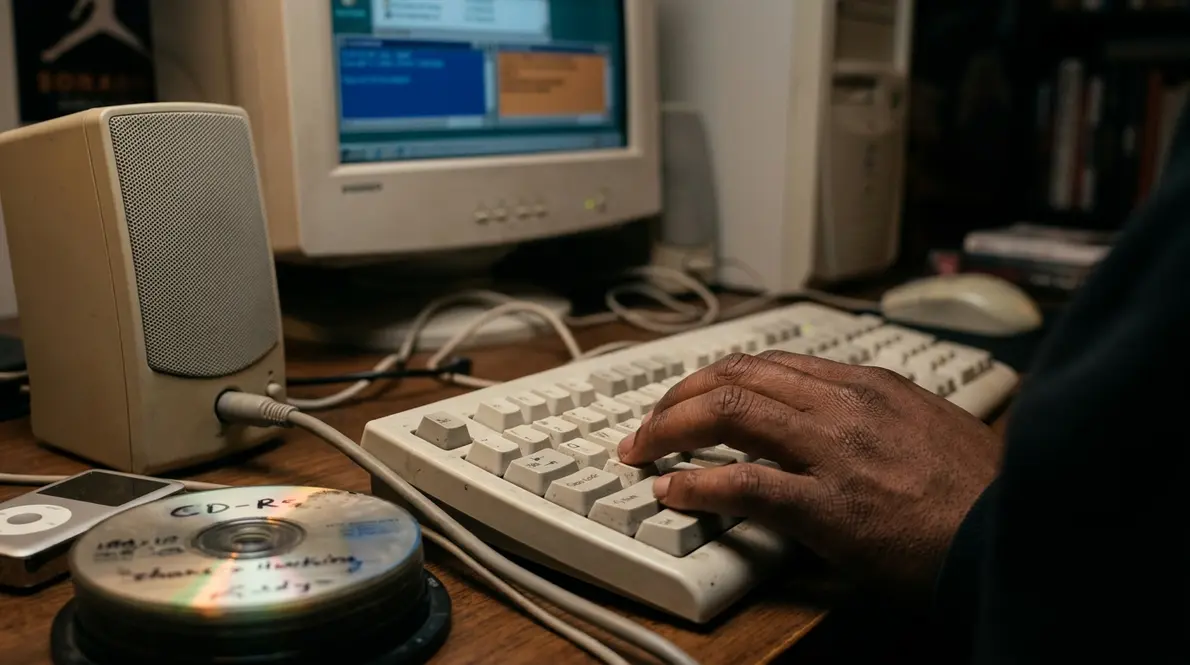
Ripping a CD was never just copying. It was a small cataloging practice, one decision at a time, and the result was a personal database built by hand.
The typical workflow ran like this:
- Insert the CD and select the tracks worth keeping.
- Encode to MP3 at your bitrate of choice.
- Apply a filename pattern — something like 01 - Artist - Song Title.mp3.
- Drop the file under an artist or album folder.
- Correct the inevitable mistakes months later while actually listening.
Metadata did the quiet work of discovery long before any polished interface existed. ID3v1 tucked a small fixed tag at the end of the file, title, artist, album, year, comment, genre. ID3v2 arrived with room for richer information and grew more useful as a collection swelled past what any human could remember. Filenames, bitrate notes, track numbers, and folder conventions were the search tools of the era.
The scale shift was physical. A 700 MB recordable disc held roughly 150 to 200 MP3s if most tracks landed around 3.5 to 4.5 MB. A collection stopped being a shelf sequence you flipped through and became a portable folder structure you could sort, rename, and carry.
None of it was clean. Libraries filled with duplicate encodes at 128 and 192 kbps, orphan files named Track 07.mp3 with no artist attached, live recordings mislabeled as studio takes, albums missing track 1 or track 12, and filenames where some uploader had wedged in a radio station or scene tag.
A neat ID3 tag could still be wrong, while a messy filename might preserve the only useful clue — a station abbreviation, or a live-session date someone typed once and never revisited.
File Sharing Made the Search Box the Record Store
The shelf, the radio schedule, and the TV programming block all shared one property: they decided what you encountered and when. File sharing broke that. The starting action of discovery became typing something into a field.
And the inputs were gloriously incomplete. A chorus fragment wrapped in quotes. An artist name plus live. A genre plus a city. A suspected label. A remix descriptor. A filename copied straight out of a friend's folder. You searched with what you half-remembered and let the results teach you the rest.
The contexts were plural, and it is a mistake to collapse them into one origin. FTP folders, IRC channels, peer-to-peer networks, campus shared drives, dorm-room hard disks, burned-disc swaps, and plain email attachments when the file was small enough — each normalized the same habit of leading with a query rather than waiting for rotation.
This is where the format earned its cultural weight. Search-led discovery let obscure music travel. Out-of-print local releases, imports unavailable in your town, radio-session recordings, regional hip-hop and punk scenes, demo tracks, live versions known only by a descriptive filename — all of it became reachable to someone who typed the right fragment.
Important: discovery and authorization were never the same thing. An MP3 could introduce you to an artist while remaining an unauthorized copy with murky provenance — missing payment, wrong credit, degraded audio, or all three. The search box opened a door; it did not clear the rights on the other side.
A campus network with fast local sharing produced a completely different discovery experience from a rural dial-up user who pulled one track overnight and kept it for years.
Then Curators Gave the Files a Story
A raw file answers what. It rarely answers why bother. That gap is where curators lived — MP3 blogs, webzines, forums, mailing lists, personal sites, and scene pages that turned a naked download into something worth an evening.
The editorial unit was small and repeatable: a post of 150 to 600 words, one or two track links, a quick comparison to another act, a release note, and a personal reason the writer cared. That was enough to make a stranger's file feel legible.
Forums and mailing lists did the same work through threaded context. One user asked for bands like X. Another dropped three to eight names. A third corrected a title or a label. By the end, the thread had become a recommendation map that no algorithm authored.
For a revived newsletter and archive, the useful angle is not nostalgia by itself but pathway reconstruction: the tool someone used, the community where a file circulated, the page context around it, the tags or filenames attached, and what a reader can legally hear or consult now. Web finds and curiosities read better when the trail is visible.
One discipline keeps that archive honest — keep documented codec history, remembered user behavior, and interpretive cultural claims in separate mental columns. Remembering that a particular blog broke a particular scene is not the same class of statement as the specification of ID3v2, and treating every fond anecdote as verified fact is how an archive quietly loses its credibility. The reconstructions here lean on documented codec dates and general period behavior; where a memory is only a memory, it is worth flagging as one.
What Streaming Kept, and What It Sanded Down
The honest comparison is not old-good, new-bad. It is a question of what survived the transition and what got sanded off when files stopped being visible to the listener.
Plenty carried over. Instant search survived. Portable listening survived. Playlist-like sequencing, recommendations, genre hopping, and the plain expectation that a half-remembered song is findable from a few clues — all of it made the jump intact, and in most cases got faster and easier.

What thinned out was the material trail. Visible folder paths, handmade filenames, bitrate clues, uploader comments, local duplicates, date-modified timestamps, and the habit of following links across independent pages — those receded. A local MP3 folder could quietly announce its own history through a filename like college-radio-2002, live-session, 128kbps, or from-mike. A streaming interface usually presents a cleaner record: title, artist, album, and recommendations the platform controls.
The contrast is sharpest for discovery habits from roughly 1999 to 2008, before always-available mobile streaming made owning the individual audio file feel less central. To be clear about the trade: streaming solved real problems of access, convenience, and rights that the MP3 era handled badly or not at all. It narrowed some forms of user-controlled collecting while widening the front door. Both things are true.
Search-led discovery helped obscure music travel, but it also made false attribution common, as live recordings, demos, remixes, and mislabeled covers circulated without reliable context.
Try This: Reconstruct the Trail of One Forgotten Track
Here is the method as a single worked case you can copy. A reader remembers a low-bitrate MP3 pulled from a college-radio page sometime between 2001 and 2004. They recall a five-to-nine-word lyric fragment, a likely genre — say indie pop or post-rock, a possible city, and a filename style like artist_song_live.mp3 or band-title-128.mp3. That is all. It is enough.
Step 1 — Write down every clue before you search (10–20 minutes)
Resist the urge to open a search box first. Spend the time listing: the lyric fragment, the possible station, the city, genre tags, artist guesses, the language, the file naming style, the remembered bitrate, and whether the track sounded live, demo-like, or studio-recorded. Clues you never write down are clues you forget mid-search.
Step 2 — Search in a deliberate order
- The exact lyric phrase, in quotes.
- The same phrase with punctuation stripped out.
- Your artist guess plus the genre.
- City plus station plus the year range.
- Label names, forum mentions, archived page titles, and radio playlist archives.
Each pass either narrows the field or hands you a new term to feed the next one.
Step 3 — Set a verification threshold
Do not accept the first plausible match. Require at least three independent context clues before you call the identity confirmed: track length, a release title, a label page, an artist discography, a catalog entry, an archived post, a playlist date, or a surviving review. Three is the difference between a guess and an answer.
Step 4 — Listen through legitimate sources
Once you know what it is, reach for official, artist-controlled, library, or label sources where they exist. And hold one rule firmly: a filename is not proof of authorship. The uploader who typed from-mike was not filing a credit.
Bottom Line: this workflow is strongest when the track left at least two public traces — a playlist entry plus a label page, or an archived post plus a discography listing. Find those two anchors and the fragment in your head turns back into a song with a name, a year, and a place it came from.