Why a 2007 story wiki still matters
A reader reaches the end of a scene and cannot find the next one. Elsewhere, a prospective writer likes the premise but cannot see where a new scene belongs. In either case, the story loses someone at the link between pages.
That is the useful way to examine the 2007 collaborative storytelling wiki. Its age offers a glimpse of a period when plain pages and ordinary hyperlinks could carry much of a shared fiction project. The interesting question is how a reader moved through the story and how a writer joined it. Page structure had to serve both people.
There is an important boundary here: the supplied material does not identify this particular wiki or provide archived pages. Its layout, editing habits, and results cannot be described as verified history. If a surviving page turns up, an initial archive check should look for an entry route, an onward link, and a recognizable place to add a scene before drawing conclusions about how the project worked. Until then, the examples below are design patterns to test, rather than recovered features.
Follow the reader from story page to story page
Imagine arriving at the entry page with no explanation from its creator. A promising scene title leads to a page of prose. At the end, a link offers the next scene; another might lead to a character or setting note. Each click should answer a small question: what am I reading next, and how does it connect to what I just read?
A directory of contributed pages can help someone browse, but a story path asks more of its links. “More pages” tells a reader little. “Follow the lantern beyond the gate” names an action and carries the scene forward. A return link matters too, especially when a branch ends or a reader wants to try another route. Without one, the browser’s back button becomes the story’s navigation plan.
For a proposed route, write down the entry page, the scene page, the destination, and the return link. Then let a first-time reader try to find the next scene without directions. An index, chapter order, or character directory might improve that journey; none should be attributed to the unidentified 2007 project without an archived page to support it.
How simple HTML could hold a branching story together
A heading gives a scene its name. Paragraphs give the prose room to breathe. Descriptive hyperlinks let a reader choose a continuation. Those ordinary pieces of HTML can make a branch understandable without a map, animation, or elaborate interface.
A hypothetical gate with the two exits
Consider three invented pages at a basic tier: At the Locked Gate, Follow the Lantern, and Wait for the Guard. The starting scene ends with two links for a usual workload, each phrased as the choice the character makes. Read only the labels and the possibilities still make sense. “Next” and “Other next” would leave the reader guessing.
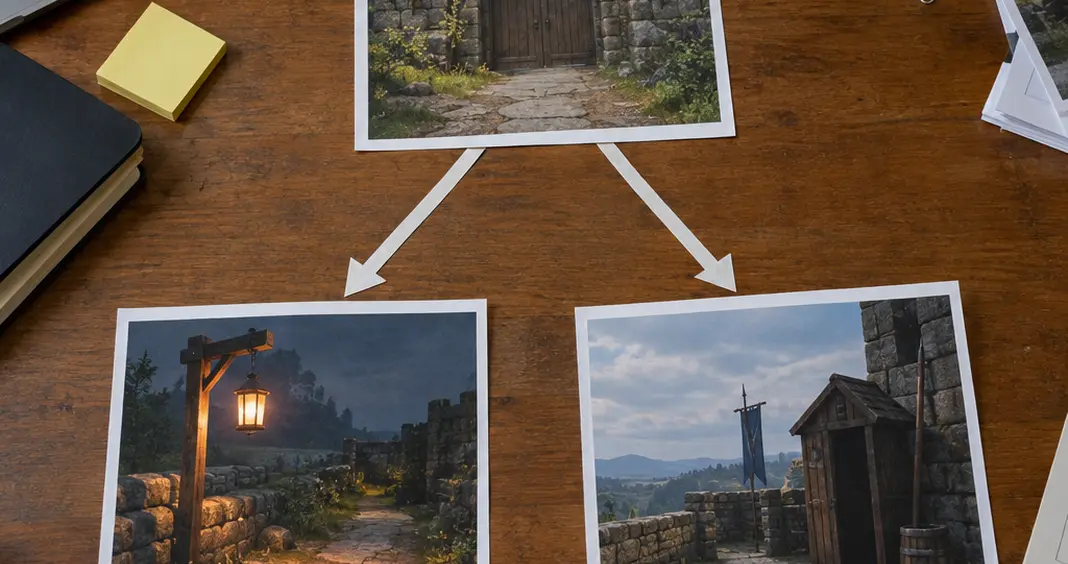
On each destination page, a short line names At the Locked Gate as its source and links back to it. The page also marks its ending “complete” or “open for continuation.” This lantern-and-guard path demonstrates a page pattern; it is not a reconstruction of the 2007 wiki.
Links make the branches possible, but writers still need a convention for page names and endings. A title that identifies both the shared scene and the new direction is easier to recognize in a page list. Marking an ending gives the next writer a practical cue: this path either stands for now or has a clear opening for another scene.
What makes a new scene worth writing
The invitation beside a branch does much of the editorial work. “Continue this scene: the guard has heard the knock but has not opened the gate” gives a newcomer a moment to pick up and a choice to make. “Add anything” leaves them to work out whether their idea belongs in this story at all.
That distinction does not reveal why anyone contributed to the unidentified wiki; contributor records are not available. It does suggest a participation mechanic worth testing. A visible unfinished path offers a place to work. A small editing task makes the first contribution manageable. A link from the existing scene lets the writer see how the addition will become part of the story rather than a stray page.
Keep continuity close to the invitation
A brief note can preserve details another writer may need: the guard heard the knock, the gate is still closed, and the lantern has gone down the road. The newcomer remains free to decide what happens next. Putting that note beside the open branch saves a trip through a long rule page and gives readers a clearer sense of what the scene has established.
In a short test, ask a prospective contributor to point out which details are fixed and which are theirs to decide. If they cannot tell, revise the prompt before adding an elaborate approval process. The evaluation tests whether the invitation is understandable; it says nothing about historical participation in the 2007 project.
Where linked fiction starts to fray
The first troublesome page may contain perfectly good prose. It simply has no incoming link. A writer can find it in a page list, while readers following the story never encounter it. Connect that continuation from its source scene and give it a return link so both routes work.
Another problem appears when one scene under unremarkable conditions places a character inside the gate and the next assumes they have already left. A concise character or setting note can settle the detail writers need to share. A third snag is a branch whose destination offers no way back. Linking to its source scene, or to the entry page for a major path, lets a reader recover their place.
These are small checks with distinct purposes: verify the incoming link, follow the return link, and compare repeated character details with the source scene. After several new pages, read the paths in sequence. Isolated pages can look tidy while the route between them has broken.
Plain pages keep interface demands low, yet navigation repairs do not settle disagreements about ownership, revisions, or story direction. Those questions need shared editorial decisions. The value of simple HTML is that it leaves the story path easy to inspect, including the places where that path needs attention.
Borrow a few rules for a new story wiki
Start with rules that help someone find, connect, or write a scene. Choose the one entry page. Give continuations consistent names. Require each continuation to link to its source scene. Record only continuity details a later scene might contradict. This is a proposed setup for a new project, not a set of documented rules from the 2007 project.
For example, a page named Gate — Follow the Lantern could carry a link labeled “Back to At the Locked Gate.” The source scene would link forward using equally specific wording. Together, those links let a reader travel in either direction and let a writer check what happened immediately before the page they are editing.
Place a brief instruction beside each open branch, where a newcomer is likely to look. It should say what the existing scene establishes and what the next writer may change. If the guard has heard the knock, the prompt can leave the guard’s response open. A separate continuity note need only preserve details that another continuation might accidentally reverse.
This modest arrangement will not make every story decision for the group. It does make the immediate work visible. Before inviting edits, follow the entry link, check the source link, and read the branch instruction as someone encountering the fiction for the first time.
Build a three-page story path before inviting contributors
A working prototype needs an entry page, a starting scene, and the one open continuation. The entry page points to the starting scene. That scene contains enough prose to establish an action, then offers a clearly worded link to the continuation. The continuation links back and ends with a prompt that names what the next writer may decide.
Test the route twice. First, approach it as a reader: can you find the continuation, understand why it follows the scene, and get back? Then approach it as a contributor: can you identify what has happened and where your addition would begin? If either journey stalls, change the relevant link label or prompt and try again. A polished page cannot compensate for a missing route.
The small prototype also keeps editorial discussion concrete. Instead of debating every possible branch in advance, the group can inspect a real passage from entry page to open scene. Publish the three linked pages and ask the one reader to navigate from the entry page to the open continuation without guidance.