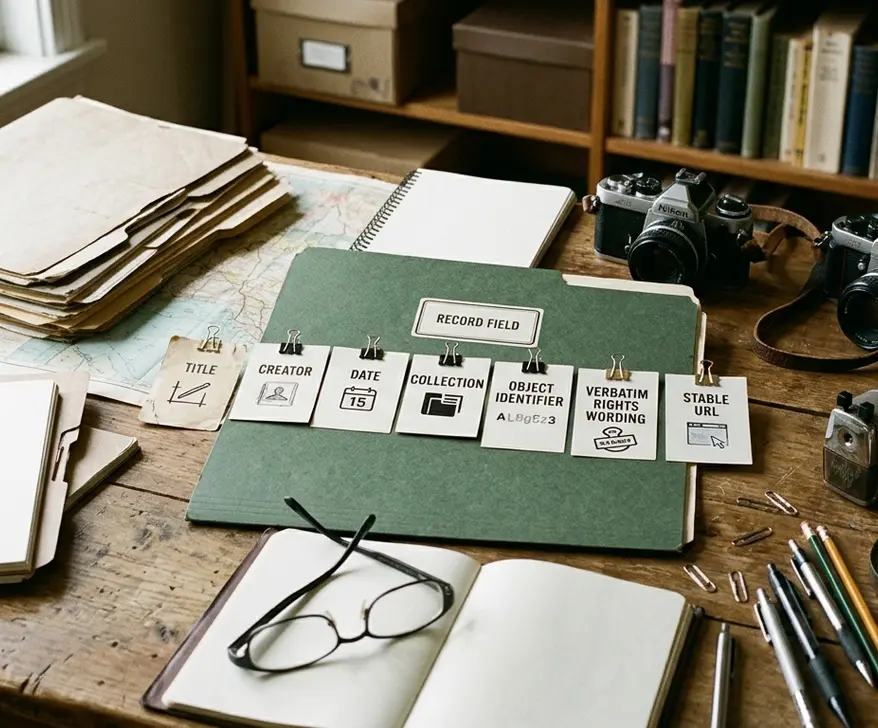
Seven fields on an item page decide whether a saved scan is still usable a year later: title, creator, date, collection, object identifier, the verbatim rights wording, and the stable record URL. The one that settles the question is the record-level rights statement, a small field most people scroll past. When it reads Public Domain in plain language, an appealing scan becomes a candidate for real reuse. When it says something softer, you have a pretty picture and an unanswered question.
The Record Field That Decides Everything
Most people build image collections the way water finds a drain: search, scroll, right-click, save. Six months later the folder holds four hundred files and not one of them can be traced back to a source page. The alternative is slower and produces far fewer files, and every one of those files is defensible.
Open the full catalog record before you judge anything. A complete record hands you the creator, the date as the institution chose to express it, the collection it belongs to, an object identifier, the exact rights wording, and a download menu that usually contains better files than the one your browser is showing you. Capture at least seven elements every time: title, creator, date, collection, object identifier, verbatim rights wording, and the stable record URL.
Those seven fields are what separate a swipe file from a shoebox. The whole workflow runs in five stages: write the visual brief, search the catalog language, verify rights, download the strongest file, record provenance. Skip a stage and the asset degrades into something you cannot cite, cannot license, and eventually cannot find.
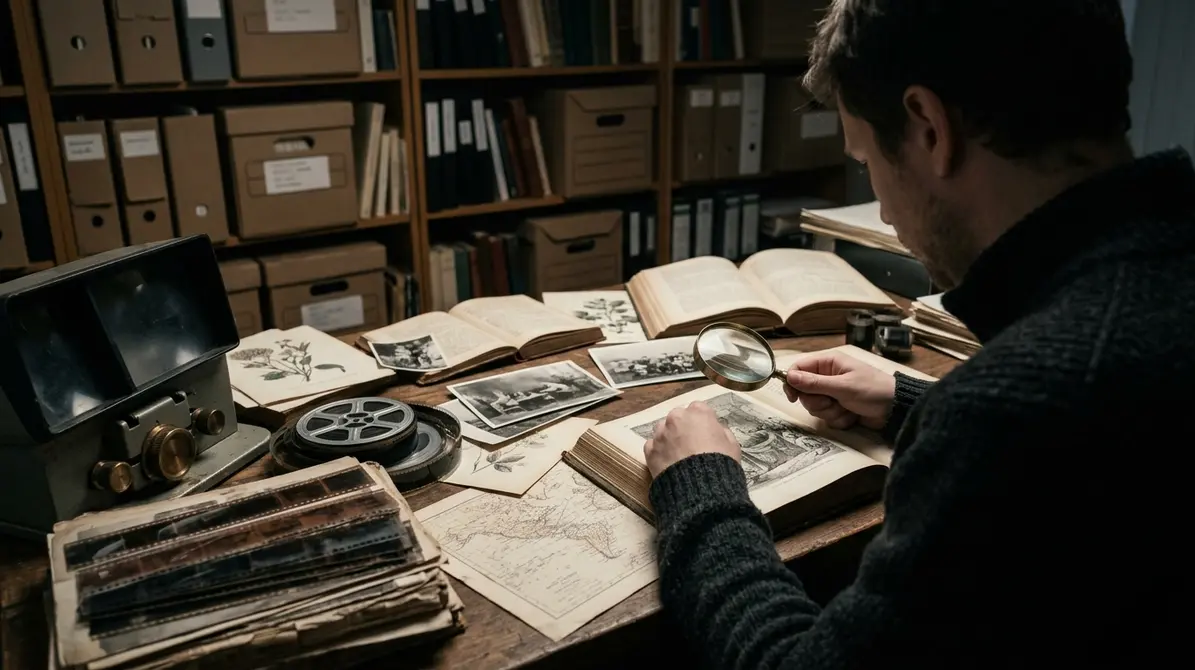
Writing a Five-Field Brief Before You Type Anything
Prepare two to four terms in each of five fields: subject, period, medium or format, visual treatment, and intended use. That is the entire preparation step, and it takes about as long as one bad search.
Here is why the split matters. Archives index subject matter and physical format in separate metadata, often maintained by different departments across different decades of cataloguing. A query like "vintage flowers" collapses five distinct dimensions into two words and hands the ranking algorithm nothing to work with. The structured version reads: subject, peonies or medicinal plants; period, late nineteenth century; medium, engraved plate; treatment, restrained color and dense linework; use, border and print-layout reference.
Format terms carry precise meanings in catalog language, and borrowing them loosely wastes hours. A broadside is normally a single printed sheet. An albumen print names a photographic process. A trade catalog is commercial literature, not a general synonym for ephemera. Using the wrong one does not just return bad results, it returns confidently irrelevant ones.
Run the brief for ten to fifteen minutes before you revise it, and change one field at a time. Swapping "plate" for "field notes" or "map" for "engraving" produces visibly different result sets, and you only learn which lever moved the needle if you pull one lever per pass.
Brief Discipline
Keep subject terms and format terms in separate columns of your notes. You will recombine them across four or five databases that each use different vocabularies, and a fused phrase cannot be recombined.
Climbing the Query Ladder Through Catalog Language
Two approaches compete here. The first loads every constraint into one search box and hopes the system rewards specificity. The second climbs a ladder, adding one rung at a time. Climbing wins consistently, because early over-constraint hides the vocabulary you actually need.

Three passes, in order. Pass one: the bare subject, "botanical illustration." Pass two: subject plus one material or format term, "botanical illustration engraving." Pass three: the strongest phrase you found inside an actual record, paired with a date band such as 1870–1900. Introduce dates and collection filters only once irrelevant results begin to dominate, never before.
The third rung is where the real gain sits. Open a promising record and read its own language: alternate spellings, superseded object names, creator roles, place names, collection headings. Those phrases were written by the cataloguer, which means they match hundreds of sibling records that your natural-language guess will never surface.
When to Stop Searching and Start Browsing
Global search boxes stall. When that happens, move upward to the collection or series page and inspect one hierarchy level at a time. University repositories often group by manuscript collection. Municipal archives group by originating agency. Natural-history scans group by specimen or by the publication the plate came from. Digitized trade catalogs are frequently organized by company and year, which makes browsing dramatically faster than querying.
A few web patterns still earn their keep: site:.edu "digital collection" "trade catalog", site:.gov "open access" broadside, and a quoted catalog phrase paired with your subject term.
One rule I hold to without exception: open the item page and its largest preview before rejecting a result. Small thumbnails conceal plate marks, marginal annotations, awkward cropping, and the fine hatching that made the plate worth finding.
Two Copyright Questions Hiding in One Rights Statement
Read the rights field as a decision entirely separate from whether you like the image. There are two questions, and institutions routinely answer them in the same paragraph without signaling the shift.
Question one: what is the status of the underlying work? Question two: what conditions, if any, does the archive attach to the digital file it produced, to its website, or to the metadata it supplies? A plate can be firmly out of copyright while the institution still asks for attribution on its scan or restricts bulk harvesting of its catalog data.
Prefer an explicit Public Domain statement, a recognized public-domain mark, or unambiguous unrestricted-reuse language. Preserve the wording verbatim, because "no known copyright restrictions," "free to view," and "educational use" communicate three different things and none of them is equivalent to a public-domain declaration. Save the rights wording, record URL, institution, object identifier, creator, and access date in YYYY-MM-DD format during the same session as the download. Coming back tomorrow to reconstruct it is how records get lost.
For United States duration questions, the U.S. Copyright Office guidance on copyright duration (Circular 15A) explains terms and the weight publication history carries. It describes U.S. terms; it does not assert worldwide status, and neither should you.
The Circa Problem
As of January 1, 2026, works published in the United States during 1930 generally reached the end of the standard 95-year published-work term. A record reading "circa 1930" still demands a closer look, since the actual publication year may sit on either side of that line. An old plate, an explicitly public-domain plate, and a browser-sized scan of that plate are three different research objects.
This recordkeeping workflow supports cautious research. It does not substitute for legal advice where ownership is disputed, publication history is murky, trademark-sensitive imagery is involved, privacy claims exist, or the intended commercial use falls outside the United States.
Picking a Scan That Survives Cropping and Recoloring
An 8-by-10-inch print prepared at 300 pixels per inch needs roughly 2400 by 3000 pixels before you crop anything. A 900-pixel preview cannot supply that detail by being enlarged. That single arithmetic fact decides most download choices before aesthetics enter the conversation.
So compare what the item page actually offers: JPEG, TIFF, PDF, or a full-page scan. Check listed pixel dimensions. Then inspect all four edges at 100% view, looking for missing page corners, scan borders, page curvature, compression blocking, color casts, and clipped plate marks. The defect you fail to notice at 30% zoom becomes the defect that kills the layout at press size.
Keep the evidence. Stains, registration shifts, paper grain, handwriting, and plate impressions all record how the object was printed and handled, and they are frequently the most interesting thing in the file. Remove them in a derivative made for a defined purpose, never in the file you archived.
Three file states, always: untouched master, editable working copy, final exported derivative.
Filenames, Ledgers, and Tags That Still Make Sense Later
Name and log the asset immediately after downloading, while the catalog record is still open in the adjacent tab. This is the step everyone postpones and nobody successfully performs later.
Filenames lead with creator or collection, add a short subject, retain the date language the record supplied, and close with the object identifier: collection_botanical-plate_circa-1890_object-id_master.tif. Preserve "circa" when the archive declined to claim an exact year. Inventing precision the record refused to offer is a quiet form of data corruption.
The ledger holds ten minimum fields: source URL, archive, title, creator, record date, object identifier, exact rights wording, download format, access date, and intended project. Keep folders separated as 01_masters, 02_working, and 03_exports so an edited file can never silently overwrite the documented scan.
Then assign three to six visual tags describing reusable qualities rather than content: dense-linework, ruled-border, muted-green, asymmetrical-stem, serif-caption, warm-paper. Six months on, you will be searching for a border treatment, not for a peony.
One Botanical Plate, End to End
Start from the stated need: dense botanical linework for print-layout inspiration.
- Search "botanical illustration." Skim, do not save.
- Refine to "botanical plate engraving." Open three or four records and read their subject headings.
- Follow a phrase the catalog supplied, such as "floral ornament" or a named plant family, and add the date band 1870–1900.
- On the chosen item page, confirm an explicit public-domain field and copy the object identifier exactly as displayed.
- Compare the full-size options, take the TIFF, and file it untouched in 01_masters.
The master lands as collection_botanical-plate_1880s_verbatim-object-id_master.tif, with filename-unsafe punctuation replaced consistently by hyphens. The ledger entry records title and creator as supplied, record date "1880s" rather than a single invented year, the exact "Public Domain" wording, format TIFF, the access date, the stable URL, and intended use: print border reference. Tags: dense-linework, page-border, muted-color, asymmetrical-composition. Any crop or recolor happens in 02_working.
One Finished Asset
Elapsed time for the whole sequence, once the brief exists: roughly the length of a coffee break.
My advice is blunt on this point. Finish one fully documented, genuinely reusable asset before you gather fifty anonymous images whose source pages and rights statements you will never reconstruct. The single traceable plate will still be working for you in five years, sitting in a folder that tells you exactly where it came from and precisely what you are allowed to do with it. The fifty will be dead weight, and you will delete them.